
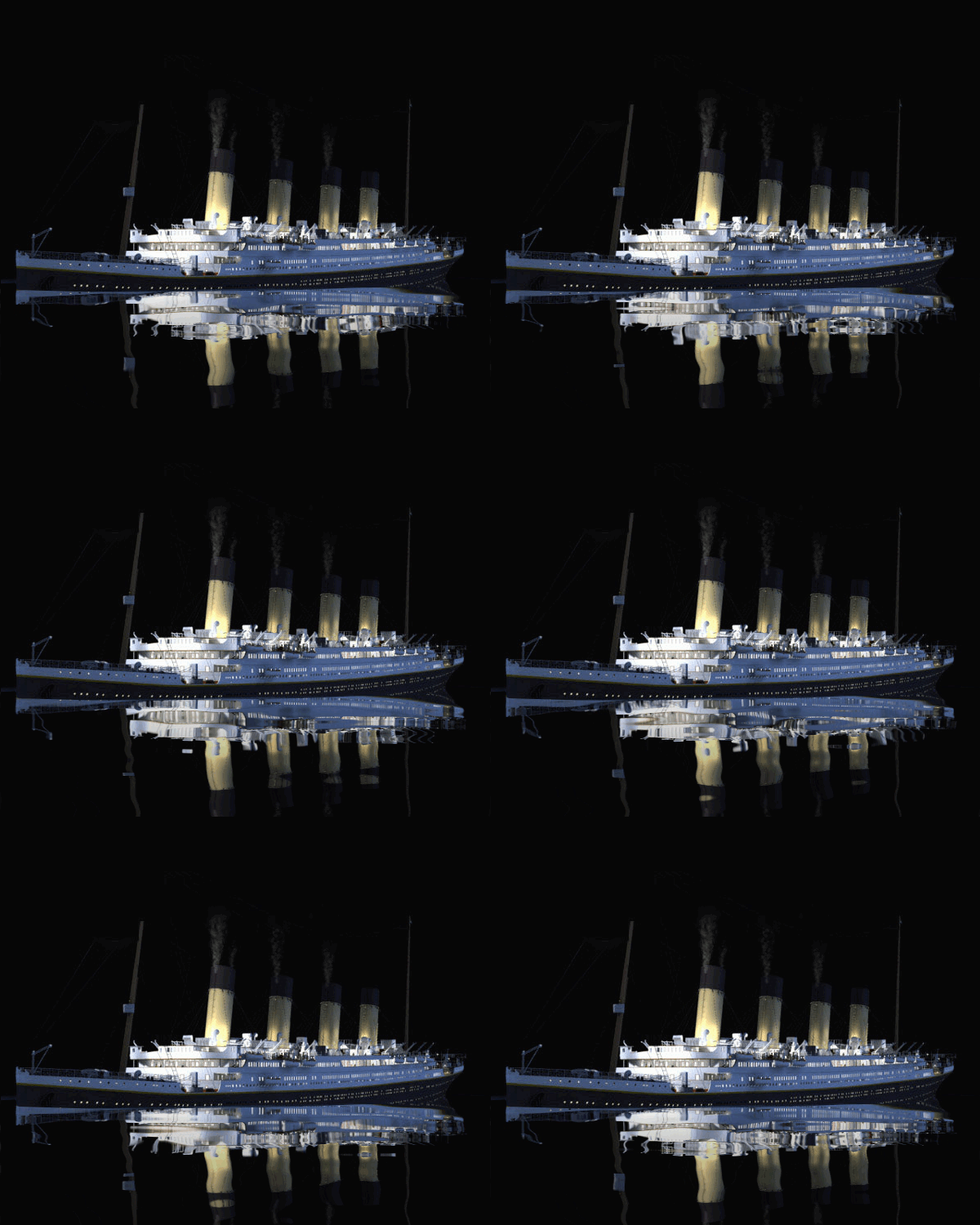


This is the best video I've ever seen during all of my Titanic research (nearly 60 years worth) that lays out how an insurance fraud scam could have been pulled off. It's well worth watching. I've watched it myself half a dozen times.
The above video mentioned the riveted steel plates bearing the name Titanic and that two of them had fallen off revealing the letters M and P underneath. So knowing the switch theory debunkers will come out of the woodwork on this...
The Camera Lens Doesn't Lie
The camera lens doesn't have an opinion nor does it lie. It merely records what it sees. Below is a screenshot of the letter M and P on the hull of the "Titanic". There is no M or P in the name Titanic but there certainly is an M and P in the name OlyMPic.

And more photographic evidence exists that it is Olympic at the bottom of the Atlantic and not the Titanic.

Although the two ships were nearly identical, their bow windows were very different. Olympic had more rectangular windows that were unevenly spaced. Titanic had square bow windows that were evenly spaced. Olympic also had a square hole by the bow windows, Titanic had no such hole.
The wreck at the bottom of the Atlantic has Olympic's bow windows and square hole.
Now that we have that established...

The sinking of Titanic is likely the first major false flag committed by the cabal - an insurance fraud scam of unimaginable proportions, designed to save the White Star Line from bankruptcy.
The White Star Line was founded by the Ismay family but as the shipping industry prospered in the late 19th century, some sought to create a trust that would monopolize U.S. shipping companies. However, all negotiations in this regard in the 1890s fell short. The intervention of John Pierpont Morgan, one of the richest men in the world, changed that.

JP Morgan
Meanwhile, J. P. Morgan had already concluded agreements with Clement Griscom, president of the International Navigation Company, which operated the Red Star Line and the American Line. Finally, in December 1900, after six months of negotiations, the Atlantic Transport Line joined INC.
Morgan would go on to own the International Merchant Marine or IMM.
Since 1902, IMM had an agreement with Lord Pirrie, chairman of Harland & Wolff and member of the management of the White Star Line, stating that all the ships of the company would be built by Harland & Wolff.
In 1908 Harland & Wolff was authorized to build the White Star Line's Olympic-class ocean liner trio: RMS Olympic, RMS Titanic, and HMHS Britannic.
When JP Morgan purchased the White Star Line, Bruce Ismay remained on as chairman and managing director of the White Star Line and president of the International Mercantile Marine Company.
At the time it was reported the White Star Line was in good financial standing. However, that was anything but the truth as recent discovery of a second set of White Star Line financial ledgers bore out. The White Star Line was heavily in debt for various lawsuits and in debt to Harland & Wolff for its shipbuilding services. White Star Line was on the verge of bankruptcy.
According to both his personal friends and business colleagues, JP Morgan was ruthless when it came to business and making money. It was Morgan's ultimate goal to monopolize the very profitable Northern Atlantic routes, of the immigrants lined up to travel to the U.S. and start their new lives there.
The Coal Strike

Bruce Ismay
To further complicate matters in 1911-1912 there was a coal strike on. This left most ships docked in the Southampton Harbor, unable to travel their usual routes for lack of coal.
Ships docked in Southampton Harbor
One of the holes in Olympic's hull

Ships docked in Southampton Harbor due to coal strike
The only ship the White Star Line had running and providing any revenue was the Olmypic.

Captain EJ Smith
Captain EJ Smith was known as the "Master of the Atlantic Routes", he'd been sailing them for 26 years.
He was also the Captain of the Olympic.
He went down in history as being this heroic figure and ship Captain.
I beg to differ. Smith was known to his ship captain peers as a reckless daredevil, often driving his ships like a speedboat. His record shows he wrecked at least four ships prior to taking command of the Olympic.
He managed to turn White Star Line's only operating ship Olympic, into a hunk of scrap metal in his collision with the HMS Hawke in the Solent, off the Isle of Wight, on 20 September 1911.


One of the holes in the hull of Olympic
The collision left two huge gaping holes in the Olympic's hull, one above the waterline, one below. In addition, the propeller shaft and propeller were damaged and the hull itself was twisted, which left Olympic with a permanent list. Yet somehow the Olympic managed to limp back to Southampton.
There it was determined that in order to repair the Olympic, the ship would need to nearly be completely rebuilt since its hull was twisted - and even if she was repaired she would never pass another Board of Trade inspection for seaworthiness. What Morgan and Ismay had on their hands was 45+ tons of scrap metal - that was the only ship they'd had running at the time.
This was nothing short of disastrous for the on-the-verge-of-bankruptcy White Star Line and by all accounts JP Morgan was a man who wouldn't tolerate losing money.
I originally set out to debunk the switch theory. Instead, I ended up believing that's just went down. And I've seen the cabal pull these switches ever since.
I spoke to several seamen who all told me maritime insurance fraud takes place on a daily basis even today.
I also spoke with an Irish shipbuilder whose grandfather helped build both the Olympic and the Titanic at Harland & Wolff in Belfast and had told him everything that had gone down and that the two ships had indeed been switched.
Management had threatened them with loss of their jobs (and more) if they even as much as whispered about such an event taking place. If you're not involved in no wrongdoing, you have no reason to threaten your workers.
The Lifeboats
Much has been made of the fact 'Titanic' did not have enough lifeboats aboard and understandably so. But you're thinking in today's terms on that front, not 1912 terms. Unlike today, lifeboats weren't seen as lifesaving devices. They were thought of in terms of being ferries that would transport passengers off a ship to another ship that had responded to a ship in distress. They were shuttles used only to transfer passengers onto another ship.
Legally, 'Titanic' had more lifeboats aboard than she was required to carry. However, there is a forgotten Inspector who has been forgotten by history. His name was Maurice Clarke and he battled White Star Line on the fact he felt the ship needed 50% more lifeboats than she was carrying. In the end, White Star Line pressured Clarke to cease and desist when he himself spearheaded borrowing lifeboats from ships unable to run due to the coal strike and transferring them to 'Titanic'. This was how 'Titanic' came to have the four collapsibles aboard that she did the night she sank.
Had White Star Line management listened to Clarke many more lives could have been saved that night the ship sank.
But as you'll come to see, White Star Line management cared far more about money than they did the loss of 1507 lives. The victims of Titanic were mere pawns in their insurance scam game and little more.

Clarke securing more lifeboats for 'Titanic'
Fire Aboard 'Titanic'
When I spoke to the seamen I did I asked each one "What's the worst disaster that could happen on a ship at sea?
and they all gave me the same answer - fire.
There was a fire in 'Titanic's' #10 coal bunker burning for a full week before the ship set sail. JP Morgan did nothing to attempt to extinguish this fire. He added 400 more tons of coal on top of it. My theory is that this is what they'd use to get passengers off the ship. I don't know if this was their Plan A or Plan B...but it doesn't matter. The point is Morgan stoked this fire rather than extinguish it.
Senan Molony is an Irish journalist and researcher with more than 30 years of experience investigating the Titanic disaster. He has spent decades studying the ship’s history, wreckage, and possible causes of its sinking, challenging the long-held belief that the iceberg was the sole cause.
In 2017, Molony revealed that a rare set of photographs — taken by the chief electrical engineer of Harland and Wolff, the Belfast-based company that built the Titanic — showed a 30-foot-long black streak on the hull’s front starboard side, just behind where the iceberg struck. These images had been stored in an attic in Wiltshire, England, for over a century, and were acquired by a descendant of a Harland and Wolff director before being sold to Molony and a collaborator. Source
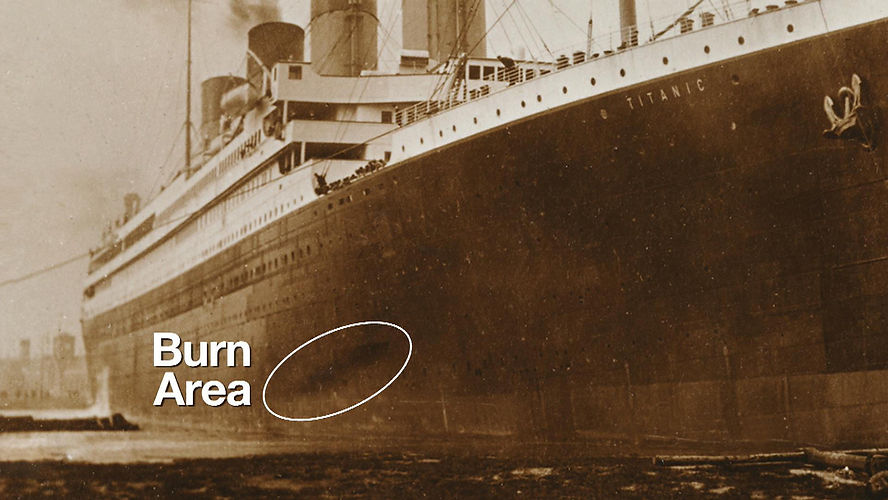
I then found an article stating Ismay had turned the ship around at the boarding dock so that boarding passengers wouldn't see this burn mark as they were boarding 'Titanic'.
That coal bunker fire burned so hot it weakened the hull, bulkheads and rivets in the hull. Perhaps not so coincidentally, this burn mark was in the same location the ship hit the iceberg.
Amazingly enough, this fire was still burning when the Titanic sailed. Even worse, the ship’s crew knew of this but was under intense pressure to sail anyway… and they did. The Fire That Sunk Titanic
Coal fire specialist Guillermo Rein stated that when heat is trapped in a bed of coal, it spreads and branches until it begins to smoke. It doesn’t take long for the coal to catch fire and it could take days, if not weeks, for someone to notice.
By the time someone senses it, it’s too late. Once a fire like that starts to burn, it’s extremely hard to put out. With that much quantity of coal, the fires can burn anywhere between 1,000–2,000 degrees Fahrenheit — the equivalent of molten lava. That melts metal — including steel.
The Titanic sailed because of the sheer determination of one man: White Star Line chairman and managing director J. Bruce Ismay.
Budget Cuts

The White Star Line was struggling to compete with its competitors. Ismay and his investors were trying to keep their heads above water as they placed their bets in the transatlantic shipping wars. The competition was brutal.
Chief designer Thomas Andrews oversaw the construction and design of the RMS Titanic. But Ismay was on a tight budget. The company was tanking and he wanted his monolithic ships out on the water as soon as possible with little cost as possible.
As Andrews rolled out his plans for a luxurious cruise liner, Ismay insisted on budget cuts. He wasn’t talking small cuts either. Andrews argued there would be corners Ismay couldn’t cut, such as steel quality and the number of lifeboats. Ismay dismissed his concerns. When steelworkers advised Ismay that it’s best to use reinforced steel, he responded haughtily and informed the steel company that “ordinary” steel would suffice.
Modern day metallurgists have since analyzed the steel and rivets used to construct the ship. They found the steel was of an inferior grade, containing a significant amount of slag. Slag is a byproduct made from melting iron ore or scrap into steel.
Not only was the company’s reputation on the line, but his reputation was on thin ice. The fire pushed the launch continuously until Ismay had enough. Wealthy investors were watching one delay after another, and the last thing the White Star Line wanted was an excuse for investors to turn their attention — and money — away.
And so, Ismay decided for the Titanic to set her maiden voyage on April 10, 1912 — fire or no fire. None of the passengers knew there was a fire burning in the ship. In fact, Ismay made sure no one knew. Source
But that wasn't the only crucial cut Ismay made, although I suspect the insurance fraud scam was already in play by that time and Morgan, Ismay and Pirrie planned to sink Olympic, claiming it was Titanic. If they were to sink it, they'd have to have a way to get around its 15 watertight compartments.

Originally the bulkheads for these watertight compartments rose all the way up to the deck above them, ensuring water wouldn't spill over from compartment to compartment if a compartment flooded.
Ismay had Andrews lower these bulkheads so they didn't go all the way up to the decks above them, but would allow water to spill over the tops of them, flooding each successive compartment - as they did the night of the sinking, the first six compartments flooding and dragging the ship down by the bow.

After all, if you're going to scuttle a ship you need to be sure the thing will sink. I don't know if this was Ismay being devious, cheap, stupid or all three combined.
Insurance
Switch theory debunkers like to point out that sinking the Olympic as the Titanic wouldn't have paid off. Incorrect.
Olympic, Titanic & Britannic An Issue of Finance
White Star Line upped their insurance on the Titanic significantly before Olympic set sail as Titanic. Furthermore, most people only take into consideration the ship carried one insurance policy. That's not the case with ships.
There are several types of marine insurance, each designed to address specific risks.
Hull insurance covers the physical damage to a vessel, while cargo insurance protects the goods being transported.
Marine liability insurance, on the other hand, protects against third-party claims and damages.
The Titanic carried both hull insurance and marine liability insurance. As scrap metal Olympic was worth little. A new ship Titanic would have been worth considerably more.
The Olympic and the Titanic were fully insured for £1m each. That's roughly $1,347,700 in US dollars.
The RMS Titanic, owned by White Star Line, was insured for £1 million to cover hull and machinery — a very large sum at the time, given that total marine insurance claims in 1912 were only about £6.75 million. The risk was placed in January 1912 by broker Willis Faber & Co., with coverage distributed across dozens of Lloyd’s syndicates, each taking between £10,000 and £75,000. The premium for the Titanic and its sister ship, the Olympic, was reported at around £7,500 per vessel. Source
The White Star Line paid out only $664,000 in settlement of all claims arising from the sinking of 'Titanic'.
Of that amount, approximately $500,000 would be distributed among American claimants, $50,000 to British claimants, and $114,000 would be required for interest and expenses in connection with the numerous lawsuits.
But Lloyd's of London didn't just make one payout to White Star Line. There was a second secret payout made, the amount of which we still don't know to this day.
White Star Line made out handsomely, enough to pull it back from the brink of bankruptcy. The survivors and victims' families didn't fare as well at the hands of the White Star Line. But we'll get to that a bit later.
Repairs To Olympic
Switch theory debunkers also insist that because the propeller at the bottom of the ocean is stamped with the number 401 that proves the ship is the real Titanic. No, it doesn't.
One of the main reason Olympic and Titanic were built to be identical ships was for financial/money-saving reasons. Their parts were interchangeable.
According to the Irish shipbuilder I spoke to, at Harland & Wolff there was a massive warehouse that housed ship parts. Olympic's number was 400 because it was the 400th hull Harland & Wolff built. Titanic's number was 401.
In this massive warehouse Olympic's and Titanic's spare parts were located right next to one another.
The shipbuilders were under intense pressure to get ships built fast. So fast they were only allowed 4 minutes per

day to use the bathroom. As the shipbuilder explained it to me, men retrieving parts could easily grab a 400 part number thinking it was a 401 part and vice versa. No one would have thought much of it since the parts between the two ships were interchangeable. But that was not how a Titanic #401 propeller ended up on the Olympic. It was deliberately installed on the Olympic after its collision with the Hawke.
Back then, these propellers were state-of-the-art so cost tens of thousands of dollars apiece. That was a big chunk of money to have to lay out in those days. So Harland & Wolff would stock only the minimum as far as propellers since they were interchangeable on the two ships. There was no #400 Olympic propeller in stock at the time repairs were being made on her. Titanic had not yet been built and fitting and installing her propellers was a way off in the future.
So the Titanic #401 propeller was installed on the Olympic to get it up and running again. And this fact is a matter of written record.
So a propeller number 401 proves nothing as far as the identity of the shipwreck. Unfortunately that single propeller was the only one found as the others are buried under feet of silt and lost forever so we'll never know what number they had stamped on them.

However, a very interesting fact would come to light when the 'Olympic' was decommissioned and her parts auctioned off between 1935 and 1939. The owner of the White Swan Hotel in Alnwick, Northumberland purchased quite a few items off the 'Olympic' including a staircase, a fireplace and a bunch of paneling. Guess what number he found stamped on the back of all that paneling? #401 Titanic.
Olympic was completed in May, 1911 so was already built and under sail whereas Titanic wasn't completed until April, 1912. That being the case, #401 Titanic paneling would not have been used on the already built Olympic. It's paneling had already been installed the previous year if not before.

This supports the switch theory that the real Titanic had been running as the Olympic, well after 'Titanic' sank.
Repairs Due To Collision With Hawke

The gaping hole in Olympics hull above the waterline required extensive repair that extended a full 1/3 of the length of the hull as designate by the arrow above. You can clearly see the patch job. What modern day deep sea explorers discovered in visiting the wreck was this huge section of repair in 'Titanic's' hull was made of a different type of construction than the rest of the ship - identifying the wreck as that of the Olympic. Titanic was a brand new ship that hadn't yet seen the water apart from her sea trials so had no such repair job - or any repair job.
Other Oddities
Last Minute Cancellations
JP Morgan was set to sail on the ship and at the last minute, feigned illness to cancel his trip. The next day the press found him in perfectly good health, frolicking in France with his mistress. He'd also had several very valuable croze statues loaded onto 'Titanic' to ship to New York and had them removed from the ship 1 hour before it set sail.
Ismay's wife also feigned illness to cancel her trip on 'Titanic' only to be discovered on a motoring holiday with her children.
In addition, over 50 personal friends and acquaintances of JP Morgan's also cancelled sailing on 'Titanic' at the last minute. In addition, all but 2 firemen and stokers refused last minute to sail on 'Titanic'. This at a time when there was a coal strike on and thousands of men were out of work.
Board of Trade Seaworthiness Inspection
Maurice Clarke performed the final inspection of the 'Titanic' the same day she set sail. Clarke’s inspection was part of the Board of Trade’s certification process, which concluded that the ship was seaworthy. However, later revelations from his own handwritten notes — now made public — show that he had privately warned that the Titanic needed “50% more lifeboats” and that the ship was not fully compliant with safety regulations. He indicated that if he had made this recommendation official, his job would have been at risk due to pressure from the ship’s owners that he certify the ship seaworthy.
What wasn't publicized was the fact that Clarke was prevented from inspecting below decks by White Star Line executives. No doubt, they didn't want him discovering they had a raging fire burning in coal bunker #10 which would've caused Clark to say "This ship ain't going anywhere!" and put an end to their insurance fraud scheme.
Crew Replacement

The Olympic–Titanic crew swap occurred the night before Smith left New York for Belfast on 1 April 1912, which was about a week before Titanic’s scheduled departure from Southampton on 10 April 1912 Titanic's Officers.
In other words, the Olympic crew change happened roughly seven days before Titanic’s maiden voyage, and Smith had already been in command of Titanic for a week by the time he arrived in Southampton.
Why would Capt. Smith make this unprecedented move a mere 7 days before the 'Titanic' set sail? Why would he replace Titanic's crew with Olympic's crew at all? The only reason I could come up with was that he felt Olympic's crew would be loyal to him and keep their mouths shut about what was going down with the insurance fraud. And I'm sure they played along having been told a ship would be standing by to rescue them so they felt nothing to lose except possibly their jobs and careers if they didn't go along with the scheme.
Yet even one of his own Olympic officers, Henry Wilde wrote a letter to his sister saying he "still didn't like this ship. I have a queer feeling about it." when he hadn't even been aboard 'Titanic' 24 hours at that point. Did he recognize he was on his old ship Olympic?
Eva Hart


Eva Hart was 7 years old when she sailed with her parents on 'Titanic'. Eva was especially close to her father, who perished in the sinking. Eva only spoke publicly once about one aspect of her rescue that night.

Eva never said what the "SCAM" was and what "all this evil" was that she witnessed. She took that secret to the grave with her.
But one has to wonder what was so awful the officer told her that when she was an adult, caused Eva to puke on him. Could it be he confirmed her father had died needlessly as a result of greed and an insurance scam? Is that the SCAM Eva was referring to? The word "evil" describes the cabal in a nutshell.
Children make the best witnesses. They don't embellish, they don't make anything up, they tell you exactly what happened as it happened - unlike adults. So I put a lot of stock in Eva's testimony.

'Titanic' Sets Sail
Titanic’s maiden voyage began at 12:00 p.m. on April 10, 1912, after being guided away from Berth 44 by tugboats. As she moved out of the dock under her own power, the suction from her huge propellers in the shallow Southampton Water drew the moored SS City of New York toward her stern. The ship’s mooring cables snapped with the force of “gunshots,” and the New York was pulled dangerously close — within just a few feet — to Titanic’s hull.
The incident caused an hour-long delay before Titanic could clear the harbor. Some passengers saw it as a bad omen, and Chief Naval Architect Thomas Andrews later called it “decidedly unpleasant”. Historians note that had the collision occurred, it could have altered the ship’s schedule, potentially changing the conditions under which she later struck the iceberg on her maiden voyage.
The ship's stewardess, Violet Jessop noted now the ship suddenly had 16 bow windows vs. Titanic's 14 bow windows. This was noticed by other passengers as well, one gentleman having sailed on Olympic numerous times. In addition, passenger Thomas Beasley and several others noted the ship had a permanent list to port - another giveaway the ship was Olympic, the permanent list to port having been caused by the twisted hull incurred in Olympic's collision with the Hawke.
The plan was allegedly in motion and the chosen rescue ship was about to enter the picture.
Captain Stanley Lord & the Californian

Capt. Lord was no stranger to maritime fraud. He'd engaged in it previously so I'm sure Pirrie, Morgan and Ismay figured they could count on Lord to play along with their scam.
Furthermore, the Californian's route ran from Liverpool to Boston so it traveled the same route "Titanic' did - and therefore, would draw no suspicion being in the vicinity of the 'Titanic'.
The Californian was moored in Liverpool when Lord must've gotten notice from White Star LIne execs it was time for him to set sail for Boston. Now, this was during the coal strike when thousands of people wanting to make their way to America were stranded since very few ships had coal to run their routes. Cargo was also stacked up at a standstill.
Yet Lord and the Californian went racing out of Liverpool with not a single passenger aboard and no cargo apart from about 2000 wool sweaters. Only enough to cover the 'Titanic' passengers. The problem was Lord took off so fast he left his navigational instruments behind in LIverpool. This meant the Californian anchored for the night not in the position she was supposed to be in but 19.2 miles away from the 'Titanic'.
Where the Californian was thought to be in 1912 is shown on the gray map. Using modern navigational equipment it has been determined the Californian's stop position was actually 19.25 nautical miles away from 'Titanic' or almost 22 miles away from the 'Titanic'.

Back at that time it was the common practice for ships captains to run their ships through the ice fields.
At the time, the prevailing rule for steamers in ice regions was to keep a steady course and speed, slowing only if fog or haze reduced visibility. The assumption was that lookouts could spot icebergs at a safe distance (about three to four nautical miles) and steer around them. This approach was considered “safe” under the Merchant Shipping Acts and was followed by many captains. Source
Given this was the practice back then it seems awfully odd that Lord would stop the Californian in the middle of an ice field for the night, send 3 telegrams to 'Titanic' reporting her position, then order his crew to keep the engines running all night in a state of preparedness. Preparedness for what? What was Lord expecting to happen?
To add to this SNAFU, 'Titanic's' navigational officer made an error in calculations in determining the 'Titanic's' actual position. So both the 'Titanic' and the Californian were in the wrong positions and not where they thought they were.
Both Smith and Lord also did something that night neither of their crews had ever seen them do. They both slept fully dressed right behind the ship's bridge, as though they were both expecting something to happen. Neither Captain had ever done this before according to their crews. So why that particular night?
The Jesuit Connection
The Vatican is the spiritual head of the cabal, the Jesuits its assassins. (If you doubt that then read the Jesuit Extreme Oath)
If there was cabal hanky panky afoot the Jesuits would have been up to their eyeballs in it.
There was one Father Francis Browne aboard the Titanic who would become infamous for the photos he'd taken of Titanic. Browne's uncle was the Bishop of Cloyne, the most powerful man in Ireland at the time. It was he who'd purchased Francis' first class ticket on 'Titanic'.

Left to right: Jesuit Francis Browne, his uncle Robert the Bishop of Cloyne & one of Francis' brothers, also a Jesuit
During the voyage Francis was befriended by a first class couple who offered to buy his ticket to continue the voyage with them to New York. This necessitated Francis having to telegram his uncle to ask permission - which he did.
I used to have a copy of the original telegram reply but lost it in a computer crash. For years I've looked for another copy of it but it appears the cabal has completely deleted it from the Internet.
So I mocked up a copy of the reply telegram to show you:

Clearly the Jesuits knew the 'Titanic' was about to be sunk in ordering Francis Browne off the ship in the manner Provincial did.
But there's a second Jesuit connection few people know about.
Capt. EJ Smith was what was called a "Jesuit of the Short Robe", meaning he held another occupation besides a strictly theological one. But he was a Jesuit nonetheless so knew if he bucked them on something he'd likely find himself pushing up daisies. If they ordered him "Sink that ship!" he would have followed those orders without question.
Browne himself narrowly avoided the Titanic's tragic fate, having struck up a friendship with a wealthy American couple who offered to cover his passage to New York - along with a return ticket to Ireland - in return for his companionship. When the priest sent a telegram to his superior seeking approval, the response was nothing short of divine intervention: "GET OFF THAT SHIP". Source
If the Jesuits were involved as the above telegram shows, there was nothing like "divine intervention" taking place, trust me. The Jesuits are the assassins of the Papacy even today. (And before I get stoned by irate Catholics, I was raised very strict Catholic including 12 years of parochial school so I'm not attempting to persecute Catholics here, just stating a fact.) The Truth about Vatican, Secret Societies, Jesuits and the New World Order
Hitting the Iceberg

That morning Capt. Smith canceled a lifeboat drill to hold a religious service. One must wonder why he did this when he was personally responsible for the lives of his 2200 passengers and a lifeboat drill had not yet taken place during the voyage?
There's one thing that's always bothered me. Capt. Smith was known as the "Master of the North Atlantic Routes" having sailed them for 26 years - without ever once hitting an iceberg. This from the guy who had a habit of hitting everything in sight. He needed a seeing eye dog on the bridge with him. But once this insurance fraud is underway his ship conveniently hits an iceberg.
Distress Flares
In 1912, a ship’s distress flares could typically be seen from about 5 to 8 miles away under good conditions, though visibility could be reduced by fog, darkness, or atmospheric haze. The weather that night was reported as being an almost eerily calm ocean and dark (although clear) skies due to the lack of moonlight.
And whether the Californian was 19.25 nautical miles from 'Titanic' or 40 nautical miles it's doubtful the Californian saw any flares being fired by 'Titanic' - white or otherwise. But it is worth noting that in 1912 red and blue rockets were typically used to signal a ship in distress - and certainly Capt. EJ Smith would have known this fact. So why was he firing off white rockets? Well, white rockets were also reportedly used to identify a WHITE Star Line ship. If that was the case, Smith was identifying the ship was the 'Titanic' to what he thought was the Californian.
The Mystery Ship
Several of the survivors in lifeboats reported they could see the lights of a ship nearby. One survivor stated it was close enough that she could see men walking around on its decks - although I question this given how dark the night was at the time.
For many years, the official story went that it was the sealer, Sampson illegally poaching and not wanting to get in trouble, fled the scene. However, many years later port records were discovered that proved the Sampson was moored at the time of Titanic's sinking. To this day, whatever ship the survivors saw, it's now referred to simply as the "mystery ship".
Mystery Ship Made Simple by Senan Moloney examines the persistent theory that the mystery ship seen by survivors was the Californian. Through geographic and navigational analysis, Moloney refutes the idea, explaining the Californian was positioned about 40 nautical miles away from the 'Titanic's' wreck site, making it impossible for the two ships to have seen each other. Moloney argues that due to known positions and courses, the mystery ship that appeared near 'Titanic' remains unidentified, challenging previous assumptions about the Californian's proximity and role during the disaster. Source
Looking at Moloney's calculations I have to agree with him - that the two ships were about 40 nautical miles apart rather than 19.25. Moloney takes into account things like the Titanic's drift while she was sinking and Roberrt Ballard having plotted the wreck's exact position in 1985 when he discovered it.
To this day, the identity of the mystery ship remains a mystery.
Breakdown Of Command
By all accounts there was a breakdown in the command structure after Capt. Smith was told by Thomas Andrew that 'Titanic' was going to sink and the Californian had not shown up as planned. I'm sure when Smith realized this meant over half of the ship's passengers and his crew would die, that reality would have hit him upside the head like a ton of bricks.
Accounts of Smith's actions vary greatly, even among his surviving crew members. Whether he had a complete nervous breakdown, was in shock or whatever state he was in, action by he and the crew to prepare to save the passengers was very slow in being enacted. Had this breakdown of the command structure not happened undoubtedly far more passengers could have been saved. From the moment Captain Smith knew the ship was sinking (about 11:40–11:50 p.m.) to the start of lifeboat loading (about 12:05 a.m.), it took roughly 20–25 minutes.
The first class had the highest survival rate of 62.46% while the lowest survival rate was among 3rd class passengers at 25.21%.
Were the 3rd class passengers locked below as the ship was sinking? There is no reliable evidence of a ship-wide order to imprison third-class passengers below while first and second class escaped. Gates and class barriers did exist, and at least one survivor described a gate being locked during the emergency. The larger record shows a more complicated failure involving separation, confusing routes, delayed guidance, family movement, and far less time to reach the lifeboats. Source
The Aftermath
While we're all familiar with what happened during the sinking itself, what happened in the aftermath of the sinking is less well known - and in some instances, absolutely shocking as to White Star Line's behavior in the aftermath.
Addergoole 14
Among the 3rd class passengers was a group of young Irish immigrants known as the Addergoole 14.
These three women were part of a group of fourteen people from the parish of Addergoole in County Mayo, Ireland, who boarded the RMS Titanic at Queenstown (Cobh) on April 10, 1912. While eleven members of the group tragically died in the sinking, Annie Kate Kelly, Delia McDermott, and Annie McGowan survived.
The three women were in bad condition and were taken to a New York hospital. Their nurses reported they were in a nearly catatonic state, barely communicating at all.
This is the first time we see the true colors of the White Star Line management. In spite of the nearly catatonic condition these women were in, lawyers for the White Star Line went to the hospital and demanded they sign a legal document that would limit the monetary damage amount they would be awarded to $25 over their entire lifetime. And none of them ever did receive more than $25 during their lifetimes from the White Star Line.
Recovery of 'Titanic's' Lifeboats

'Titanic's' recovered lifeboats at Pier 54
In the process of recovering 'Titanic's' 712 survivors, the Carpathia also receovered the lifeboats they'd been in. Carpathia was steaming for New York as fast as she could being most of those survivors were in need of medical attention for hypothermia, injuries, etc.
White Star Line demanded Carpathia dock at Pier 54 before getting the survivors the urgent medical attention they needed so that it could recover their lifeboats. After all, they were expensive! This is how little White Star Line cared about its surviving passengers. Their behavior in the aftermath of the sinking was nothing short of despicable.
Their greed doesn't put an insurance fraud scam out of the realm of possibility and even probability.
The Fate Of Captain Smith

This is where things get interesting. Survivor accounts of Capt. Smith's fate were all over the map. He was seen on the bridge going down with the ship, he was seen walking the deck when the ship went down, he swam to a lifeboat towing a little boy and once the boy was in the lifeboat Smith swam back toward the ship and drowned.
Indications are none of the above were true nor was the belief Smith perished in the sinking.
Peter Pryal, a wealthy, retired Philadelphia mariner and who was a shipmate of Smith's for 17 years claims that on July 20 he ran into EJ Smith on the streets of Baltimore and attempted to speak to Smith but Smith brushed by him angrily.
Pryal encountered him again the next day and followed Smith to a train station where Smith bought a ticket to Washington D.C. Perhaps not so coincidentally, this is where the American inquiry into the sinking was being held.
Just as he was about to go through the gates, Smith turned to Pryal and greeted him by name, saying "I am on business, don't worry me Pryal. Be good to yourself old shipmate, till we meet again." Source
Pryal was in such a state of shock at seeing Smith alive that he went to his physician, who declared Pryal was absolutely sane. Pryal knew Smith for 17 years so it's highly unlikely this was a case of mistaken identity.
And the thing is, Pryal wasn't the only one who reported seeing Smith alive after the sinking. Several people reported encountering him. Pryal also claimed Smith was too sensible a man to take his own life.
How would Smith have escaped to make it to Baltimore? The most logical conclusion was that he disguised himself as a passenger and got into one of the lifeboats - as some other men had attempted to do. In the chaos that took place that night this wouldn't have been difficult for him to do. And if his crew loading the lifeboats had recognized him, they wouldn't have likely stopped him from getting into a lifeboat.
Things got even more interesting many years later. A resident of Halifax, Nova Scotia claimed his best friend, Edward had confessed to him on his deathbed that he'd been the Captain of the Titanic. He told this man things only Smith could have known about that night and the friend claimed the man did indeed look just like EJ Smith. Ironic Smith would have turned up in Halifax given that's where a number of the 'Titanic' victims are buried.
In typical cabal fashion the man making this claim was quickly silenced and disappeared from public view.

Titanic cemetery in Halifax, Nova Scotia
The Federal Reserve Bank
There would have been a secondary good reason for the cabal and Jesuits to have sunk the ship. Three of the richest, most powerful men in the world were aboard. The cabal had planned to create the Federal Reserve Bank in order to control the world's finances. At the same time, the cabal was planning to start the next World War I as they make trillions of dollars off every war they start. They have started every war the U.S. has ever been engaged in.
While it's unclear if these three men opposed the creation of the Federal Reserve Bank, they were opposed to starting a world war and had the power to stop the cabal from doing so.

John Jacob Astor Isador Strauss Benjamin Guggenheim
All three men perished in the sinking and very shortly after 'Titanic' sank the Federal Reserve Bank was created and it did go on to control the world's finances. And on July 14, 1914 WWI started.
Here's something for you to consider when it comes to the creation of the Federal Reserve Bank...why do you supposed that out of 365 days in a year, April 15th, the same date 'Titanic' sunk, was chosen as the date your income taxes would be due? And where do those income taxes go to? The Federal Reserve Bank.
The Signing of the 1911 Secrets Act
After the sinking there were allegations made that surviving crew members were detained in a railroad shed and made to sign the 1911 Secrets Act, which was essentially a gag order that they never speak about what actually happened on Titanic that night. Reportedly White Star Line executives and at least one high ranking government official were at this meeting.
According to the grandfather of the Irish shipbuilder I spoke to, this event did in fact happen but rumors of this happening were silenced and therefore, not included in any accounts of the sinking or passenger testimonies, including those of surviving crew members. According to the grandfather, during this meeting crew members were not only threatened with imprisonment but their lives were threatened. This is consistent with cabal tactics.
Summary
In attempting to initially disprove the switch theory I used the same procedure we used in law enforcement to solve a crime. That is to set personal beliefs and opinions aside and objectively follow the trail of evidence that leads to the perpetrator(s) of a crime and the reason for committing that crime.
The trail of evidence leads to the conclusion that a massive insurance fraud scheme was perpetrated by executives of the Whtie Star Line and that planned or unplanned, over 1500 people lost their lives that night.
Not to mention we have photographic and videographic proof the wreck at the bottom of the Atlantic is the Olympicc.
As far as the British inquiry went, it was a complete whitewash job. Some witnesses even kept calling the ship "Olympic" during their testimony and were immediately corrected that it was the 'Titanic' that had sunk.
If anything the ship remains one of mysteries even 114 years after its sinking. Will she continue to give up her secrets before she ceases to exist at all? Only time will tell.